What are the factors that make a marketing campaign memorable? A bold, creative strategy, a new digital marketing idea, or the way a marketing team handles all the details from beginning to end? With social media campaigns, content marketing, and email marketing all moving at the speed of light, efforts alone are no longer enough; you need a marketing strategy that resonates with potential clients. Effective creative campaign management strategies ensure that every element is aligned for maximum impact.
In this blog, we will discuss a few of the most effective creative campaign management tactics that can help your brand run successful campaigns, engage with your audience, and get the most out of every marketing effort, including guerrilla marketing, event marketing, ways to execute digital marketing strategies, and content-driven approaches. Let’s get started:
What Is Creative Campaign Management?
Campaign management is the overall process of planning, executing, tracking, measuring, and analyzing a marketing campaign over multiple channels, and managing a team in charge of designing, implementing, and developing it. This is more than putting together some ads or putting out some content; this is about weaving together each of the moving parts so your message gets in front of the right audience on the right channel at the right time as part of a strong digital marketing strategy. An effective campaign strategy combines budgeting, timelines, channels, targets, and content.
For example, suppose you were a brand and had a new product to launch. In that case, you might run a social media campaign to gain awareness, an email marketing campaign to nurture leads, and a content marketing strategy (like blogging or video) to educate people. It’s about getting these channels working together, so the campaign is delivering a consistent brand message that’s ‘firing on all cylinders’ in terms of driving ROI, following a clear creative marketing strategy and creative concept.
In other words, good campaign management ensures that everything you do, from what you create to how it’s put out digitally, fits with and serves your larger business strategy, so that campaigns are not only smart and creative but also impactful.
Importance Of Creative Campaign Management
Effective monitoring for any marketing campaign is the spine of success. Without a system to follow, companies end up wasting so much when it comes to wasted budget, muddled messaging, and even missed opportunities. A properly run campaign, in contrast, everything funnels up to business growth and to engaging your customers.”
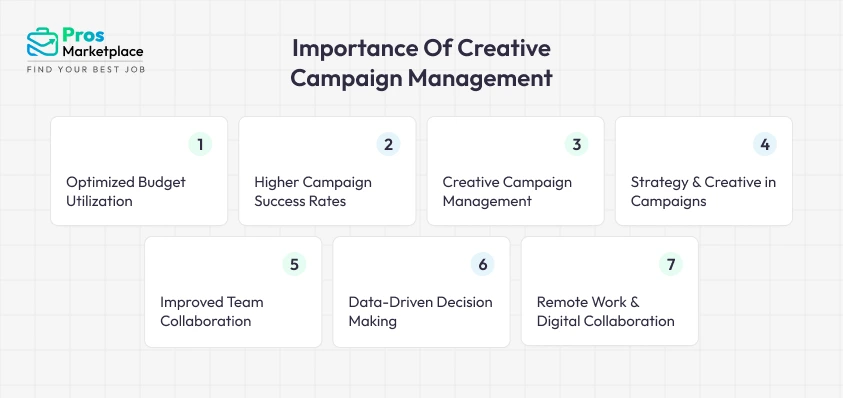
Here’s why efficient marketing campaign management is so critical:
1. Optimized Budget Utilization
Strategic planning ensures that every single dollar is spent in the right channel, to the right audience. e.g., rather than throwing money into paid ads, campaign managers can look at performance data and invest more budget into high-converting platforms like Google Ads or LinkedIn. This allows for maximizing ROI and minimizing wasted spend.
2. Higher Campaign Success Rates
A well-planned campaign minimizes mistakes, eases execution, and enhances targeting. For example, email automation software features such as HubSpot and Mailchimp enable detailed audience segmenting, which can help drive engagement and conversions.
3. Creative Campaign Management
Great marketing is driven by great creativity. The art of campaign management is blending storytelling, design, and messaging to make your campaigns memorable and drive home business goals. Think of Nike’s “Just Do It” ad campaigns: always inspired creatively, emotionally gripping, and strategically programmed to hit home when and where on a global stage.
4. Strategy and Creative in Campaigns
No creative idea, no matter how cunning, takes place in a vacuum. A good campaign strategy sets the audience, channels, timeframes, and KPIs. For instance, a startup in SaaS might have a multi-channel approach – using LinkedIn for B2B leads, SEO for organic traffic, and webinars for edification. Creativity without a strategy winds up being mere noise.
5. Improved Team Collaboration
Campaign management brings marketing, sales, and creative teams together for consistent messaging. A single, centralized workflow brings content writers, designers, and sales reps together, so campaigns appear seamless across email, social, and the website.
6. Data-Driven Decision Making
Dynamic analytics provide campaign managers with the ability to monitor best performance and shift as required. What remains are tools such as Google Analytics and SEMrush that tell marketers how their users are behaving and how to modify ad spend, content, and messaging for better results.
7. Remote Work and Digital Collaboration
Distributed teams give rise to campaign management and digital tools such as Trello, Asana, Slack, or Notion for such management. These platforms make communication better, help to track tasks and outcomes, and make people accountable— they make remote creative collaboration just as effective as in-person collaboration.
Key Components Of Campaign Management
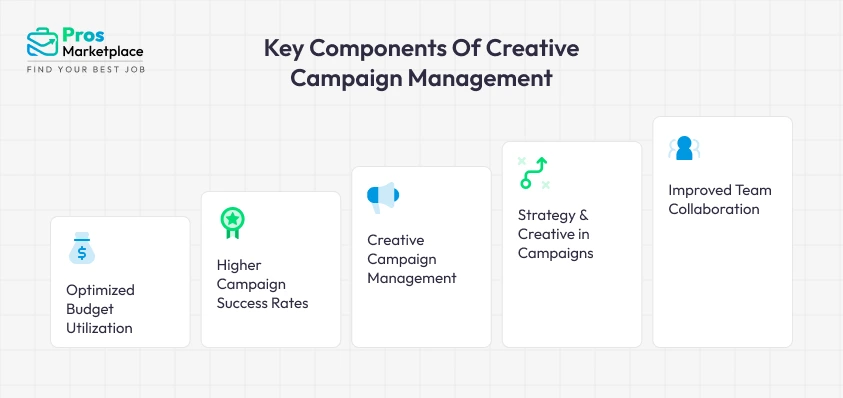
When you have a successful creative campaign, it’s about more than just running ads — it is about the alignment and orchestration of all the moving parts of a marketing campaign. Each step, from setting objectives to monitoring outcomes, is crucial to guaranteeing success. Diving into what every campaign manager and their team needs to master to make an incredible, ultra-successful impact.
1. Planning: Setting the Foundation
Clear planning is a must for any great marketing campaign. That includes establishing SMART goals – whether that’s increasing sales, raising brand awareness, or introducing a new product or service. Knowing about your audience demographics, behaviors, and preferences allows you to create the right content marketing, social media marketing, and digital marketing. Efficient Resource Allocation – to creative production, ad spend, and tech stack maximizes the impact of the campaign while closely watching for where it is aligned to business needs.
2. Strategy Development: Crafting the Path
This is the methodology that your plan will follow. Picking the right channels — Whether it’s social media campaigns, email marketing, PPC ads, or traditional methods, it’s just as important when you learn to effectively market a product and service to reach potential customers where they’re most active. Consistency is powered by creative messaging and visuals that stand for the brand. Timing and regularity are also important; a creative marketing initiative is launched at an opportune moment to maintain engagement and eliminate any risk of audience fatigue.
3. Execution: Bringing Ideas to Life
Execution turns strategy into reality. Using automation solutions, campaign managers send customized messages according to user behavior and preferences. This way, a campaign feels specific, not generic. Leadership is key here: It’s up to the sales leader to manage marketing teams and designers to make sure everyone is on the same page. The timely and reliable execution supports audience attention and strengthens the brand’s credibility.
4. Optimization: Continuous Improvement
The best campaigns don’t just end after launch. Through A/B testing — of headlines, of visuals, of CTAs — teams find out what the audience most responds to. There are two things that I learned from regular performance analysis, which are helping us become more targeted, refine our messaging and placement. This closed loop continues to keep the campaign nimble and responsive based on evolving customer needs and industry dynamics.
5. The Interaction of Components
Planning is the architect, strategy is the roadmap, execution builds the dream, tracking gauges the result, and optimization maintains the future. In concert, these elements serve as a system, assuring innovation gets results.
Effective Strategies For Campaign Management
Today, simply being creative isn’t enough to run a successful campaign; it takes strategy, adaptability, and a customer-first mentality. Although the industry undergoes a lot of changes and new challenges, companies should focus on building trust, innovation, and data-informed decision-making.
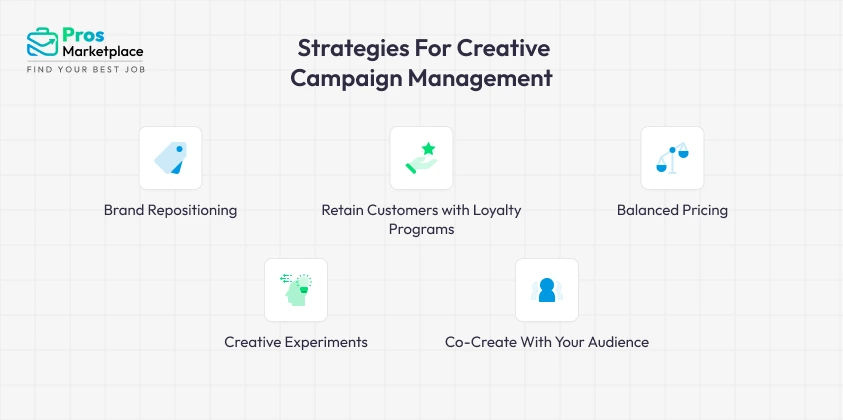
Here are some of the best tricks top brands are using to get ahead:
1. Brand Repositioning
A rebrand isn’t just slapping a new logo on something — it’s reworking how a company presents itself to its audience in a changing market. Now, companies look at their strengths, weaknesses, opportunities, and threats so they can realign messaging, refresh visuals, or tweak product names to remain relevant. For instance, businesses pivoting to digital-first services in the wake of the remote work surge adapted their campaigns to focus on the values of flexibility, collaboration, and efficiency. In fact, 74% of all companies are planning to reposition their brands in the next year – demonstrating it’s crucial in order to compete these days.
There are some useful approaches to managing position-related creative campaigns: Establishing a clear line of message, focusing on the audience, and understanding where the work should go. For distributed teams, these strategies translate to transparent communication, collaborative tools such as Trello, Slack, or Asana, and creative cloud services like Canva or Figma. From the structured workflow with flexibility built in, remote workers are now enabled to run campaigns that are unified, creative, and effective—where brand evolution can work hand in hand with the modern-day distributed workforce.
2. Retain Customers with Loyalty Programs
It costs much less to keep customers than to acquire them, and that’s why loyalty programs are one of the most effective ways to increase sales and establish trust in your brand. By incentivizing customers who shop repeatedly with unique offers, discounts, or personalized benefits, companies can deepen relationships and drive repeat behavior. These are not only revenue-boosting programs, but also a way to generate a sense of belonging that keeps customers returning.
Point-based systems, tiered memberships, and subscription boxes are among the popular ones, each with its own narrative on maintaining long-term loyalty. Indeed, over 90% of businesses already utilize some type of customer engagement or loyalty program, and this kind of participation has shown its ability to create loyal customer communities. When they are designed with the customer in mind, these programs convert one-time buyers into brand advocates.
3. Balanced Pricing
For most buyers, price is the single most important thing that governs whether or not they buy something. By rethinking your pricing strategy and adapting it to reflect existing market conditions, you can remain competitive, attract new customers, and improve revenue. If you’re in a space to do so, alternative payment plans (after-pay), bundling, subscription models, and the like can work to make your product more attainable and attractive.
Any game price strategies should be driven by what you know are your target audience’s tastes and purchasing habits. Testing and iterating on various approaches, say discounts, limited-time offers, or value-based pricing, allows you to create a balanced strategy that drives sales while still sustaining profitability.
4. Creative Experiments
It’s said innovation often results from experimentation. Structuring small creative experiments or trying out different tactics can help you find out what your audience members respond to, without requiring a big budget. Whether it’s off-beat partnerships with new brands or local artists, or limited edition product variations, experiments keep your business nimble and trendy.
The trick is to test, measure, and adjust fast. Not every experiment you try will work, but each will give you valuable feedback on customer taste, market whims. Creating a culture of experimentation can help you unlock new growth opportunities and stand out in a crowded marketplace.
5. Co-Create With Your Audience
Your customers are more than just purchasers; they’re an innovation resource. You can get people in your community involved, on social media or even at polls, feedback forums, so they vote for new features, co-design limited editions, for example. This is what builds customer loyalty to your brand.
When you market to and with your audience, not just to them, you develop deeper levels of trust and loyalty. It’s not just about innovation – co-creation is about generating products and campaigns that correlate to what your audience really wants, and killing the competition in the market space.
Top Case Studies Of Successful Campaign Management
To know what makes a real successful campaign, you need to look at real-life cases. And, some have not only grabbed attention but also transformed industries through brilliant strategy, creative concept, and engaging audiences. Digital Marketers can pinpoint the tactics driving marketing campaign goals, as well as long-term customer loyalty, by adopting the lessons of these campaigns. I’ve made a list of some great case studies that illustrate effective campaign management in action:
1. Dove
If ever there’s a campaign management lesson to be learned from, it’s the Dove Real Beauty campaign. Launched in 2004, it was a revolutionary concept that helped change the discussion of beauty standards and the way brands connected with consumers.
In place of the traditional baby white models, Dove broke new campaign ground by using real women of various body shapes, sizes, and colors. This brave but basic content marketing campaign approach not only broke down barriers but also secured loyalty for life. Effective campaign planning ensured every step aligned with the brand’s vision, and the strategy was amplified using influencer marketing.
Here’s why it worked:
- Social Insight – Dove, as a brand that actually cares about real people, made it part of a global beauty fairytale.
- The campaign was debatable – The campaign generated conversations and debates, and thereby was worth more than 150M USD in free earned media coverage. That’s a huge case of high marketing ROI through clever storytelling.
- Relevance & Brand Consistency – Decades later, Dove is still running the campaign and pushing the initiative using the Dove Self-Esteem Project. This meant keeping the brand focused on its original intention while evolving into new platforms.
2. Apple’s Shot on iPhone
One of the most famous examples of creative campaign management is Apple’s Shot on iPhone campaign. But in asking iPhone users to post photos to Instagram with the hashtag #ShotOniPhone, Apple transformed its customers into brand evangelists. The hashtag now has almost 30 million posts and is recognized as one of the most effective campaign initiatives in digital advertising.
Here’s why it worked:
- Feature showcase: Rather than pushing product specs, Apple celebrated actual photography output, elevating the iPhone as a creative tool.
- Competition element: The opportunity to have your image plastered on billboards worldwide provided the element of exhilaration and propelled people to enter.
- User-generated content: Apple used real pictures taken by users – strong social proof and brand consistency.
It’s an example of how savvy campaign management can marry creativity, community engagement, and digital platforms to grow both engagement and marketing ROI.
3. Airbnb
Airbnb, a worldwide accommodations and experiences marketplace, leveraged localization to effectively launch services in new locations. The company was launched in 2008 in California and now boasts over 1,500,000 listings in 34,000 cities around the globe. Airbnb accessed untapped markets and became a global brand by providing language localization, working with a creative agency, and creating localized versions of its website that match the regional preferences and creative elements.
Here’s why it worked so well:
- Accessibility via localisation: In localising its platform and creating content specifically for different audiences, Airbnb ensured that its services were more accessible and easier to use all around the globe, guided by a clear creative brief that aligned with user needs.
- Global expansion on a budget: By applying creative campaign management and digital collaboration solutions, Airbnb was able to grow its global footprint without spending a fortune on brick and mortar, while smartly repurposing creative assets for multiple regions.
- Brand consistency: With a strong brand identity, the company also opened space for cultural personalisation, without compromising brand integrity in different markets.
This method shows how the campaign management and localization strategy adopted can power exponential growth and boost your marketing ROI which can go on to make a company a global trailblazer—all while confidently leveraging remote style marketing discipline.
4. Starbucks
Did you know Starbucks Rewards is among the best loyalty programs out there? Customers can earn stars for purchases made in the mobile app and use them to redeem free drinks, food, or other exclusive rewards. Loyalty programs are a dime a dozen these days, but Starbucks was one of the first companies to do so at such a massive scale.
Here’s why it worked:
- Mobile First: Connecting the program with its app ensured simplicity and ease for customers to join.
- Gamified rewards: It’s fun to earn stars, which encourages repeat buys.
- Customer data insights: Starbucks leverages the program to personalize offers and increase sales even more.
The beauty of this approach is that it really is a win-win: loyalty feels rewarded for the customer, and Starbucks gets greater engagement, repeat visits, and more sales. By aligning the program with clear marketing goals, tracking campaign performance, and involving a skilled creative team, Starbucks has turned a simple loyalty system into one of the most successful marketing strategies worldwide.
Conclusion
Creative campaign management is the art of turning ideas into powerful, results-focused plans. Whether it’s brand repositioning and loyalty programmes, wacky experiments and global localization approaches, strong campaigns get the mix of creativity and execution spot-on. Examples like Dove, Apple, Airbnb, and Starbucks provide proof that digital collaboration, remote work flexibility, and consistent messaging can increase a brand’s marketing ROI. By utilizing these strategies, companies are able to create campaigns that don’t just create an initial hype but build customer trust and loyalty over the long term. Successful execution also comes from strong creative efforts, thoughtful market research, and exploring innovative creative marketing campaign ideas that resonate with the right audience.