Most recruitment letters do not fail because the role is unattractive. They fail because the letter itself gives candidates no reason to keep reading.
A generic “we found your profile impressive” opener. A vague job description that could apply to any company. A closing that tells the candidate to “apply if interested” without any urgency or direction. This is the template most employers are working from and it is why response rates on outbound recruiting are lower than they should be.
A recruitment letter is not a formality. It is the first impression your company makes on someone you want to hire. For remote hiring specifically, where the candidate cannot visit your office or meet your team in person before deciding whether to engage, that first letter carries more weight than most employers realize.
This guide covers what a strong recruitment letter needs to include, the mistakes that kill response rates, and ready-to-use templates for the most common recruiting scenarios.
What a Recruitment Letter Is Actually Trying to Do
Before writing the letter, it helps to be clear about its purpose. A recruitment letter is not trying to close a hire. It is trying to earn a response.
That distinction changes how you write it. If the goal is to close, you front-load everything and overwhelm the reader. If the goal is to earn a response, you give them enough to be genuinely interested and a clear, low-friction path to take the next step.
The letter needs to answer three questions the candidate is asking in the first 30 seconds of reading: Is this role relevant to me? Is this company worth my time? What do they want me to do next? If the letter does not answer all three clearly, you lose them before they finish the page.
How to Write a Recruitment Letter for a Job?
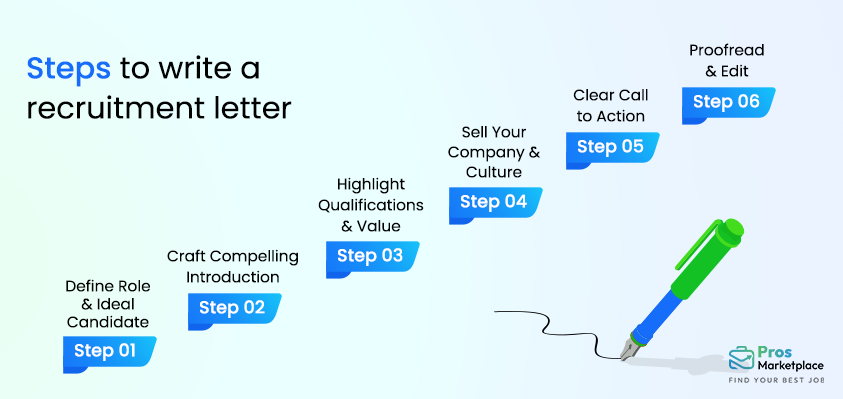
Sending a recruitment letter to a talented individual can give you the right chance and the opportunity to hire talented individuals. Here’s your guide to crafting a recruitment letter that sparks curiosity and makes them eager to join your team.
Step 1: Avoid a boring introduction
The fastest way to get a recruitment letter deleted is to open with a line that could have been sent to anyone. “We came across your profile and were impressed” tells the candidate nothing and signals that you have not actually looked at their background. A strong opening references something specific: a skill they have demonstrated, an industry they have worked in, or a problem your company is trying to solve that their background is directly relevant to.
Step 2: Explain the Job
Not a job description copy-paste. A two to three sentence explanation of what the person will own, who they will work with, and why the role matters to the business. Candidates are not just evaluating the job title. They are evaluating whether the work will be meaningful and whether the company is one where they can grow.
Step 3: Talk about your work culture
Not a list of perks. An honest answer to the question: why would a talented person choose to work here over somewhere else? For remote roles, this includes your culture, your team structure, and how remote work actually functions day to day at your company. Candidates applying for remote positions have usually been burned by companies that claimed to support remote work and then did not.
75% of candidates say the quality of a recruitment letter influences their perception of the company and whether they choose to apply.
This lets them see themselves fitting into your vibrant company culture.
Step 4: Beyond the Paycheck
For the candidate, joining a company is a lot more than money. Highlight the benefits package you offer. Whether it’s a top-notch health plan, generous vacation time, or unique perks like on-site meditation sessions, showcase your commitment to the employee’s well-being.
Step 5: A Call to Action
Tell them exactly what you want them to do next and make it easy to do. Schedule a 15-minute call. Reply with their availability. Click a link to apply. One action, not three. Every additional step reduces response rate.
Bonus Tip: Proofread!
Typos show carelessness. Remember, a personal touch goes a long way. Tailor the letter whenever possible, mentioning a specific skill or experience from their resume.
By following these steps, you can craft recruitment letters that are more than just informative – they’re engaging. They’ll attract top talent and make them see your company as the right place for their career advancement!
Recruitment Letter Examples & Templates
The templates below cover the most common recruiting scenarios. Each one is a starting point. The more you personalize them to the specific candidate and role, the higher your response rate will be.
Recruitment letter template
1. Job Offer Letter:
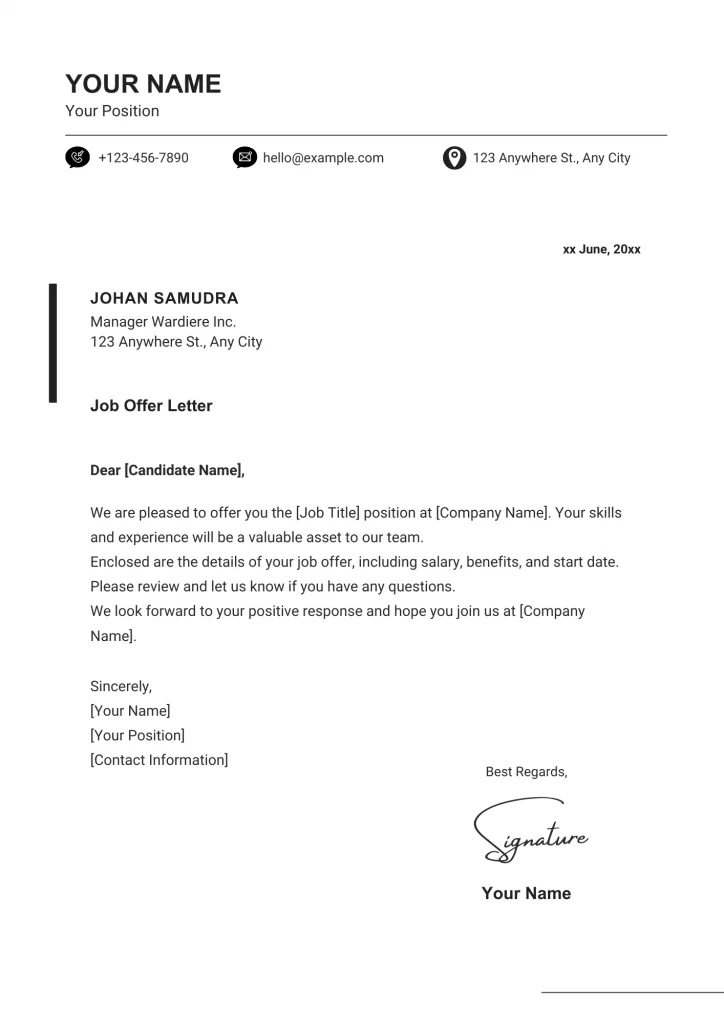
Dear [Candidate Name],
We are pleased to offer you the [Job Title] position at [Company Name]. Your skills and experience will be a valuable asset to our team.
Enclosed are the details of your job offer, including salary, benefits, and start date. Please review and let us know if you have any questions.
We look forward to your positive response and hope you join us at [Company Name].
Sincerely,
[Your Name]
[Your Position]
[Contact Information]
2. Invitation to Interview Letter:
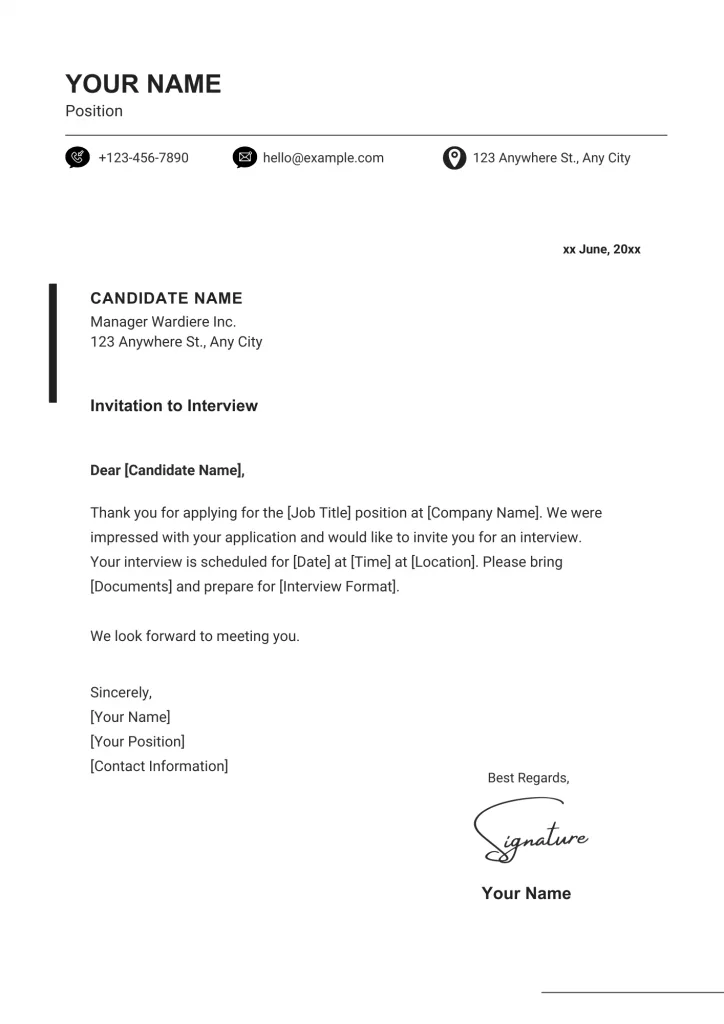
Dear [Candidate Name],
Thank you for applying for the [Job Title] position at [Company Name]. We were impressed with your application and would like to invite you for an interview.
Your interview is scheduled for [Date] at [Time] at [Location]. Please bring [Documents] and prepare for [Interview Format].
We look forward to meeting you.
Sincerely,
[Your Name]
[Your Position]
[Contact Information]
3. Referral Recruitment Letter:
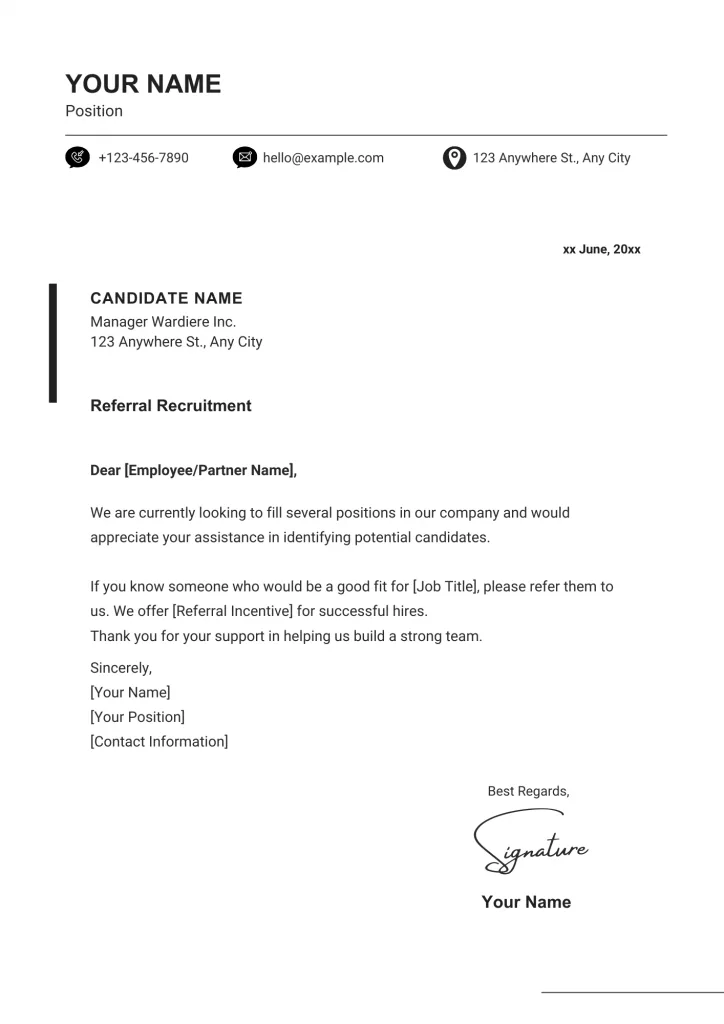
Dear [Employee/Partner Name],
We are currently looking to fill several positions in our company and would appreciate your assistance in identifying potential candidates.
If you know someone who would be a good fit for [Job Title], please refer them to us. We offer [Referral Incentive] for successful hires.
Thank you for your support in helping us build a strong team.
Sincerely,
[Your Name]
[Your Position]
[Contact Information]
4. Campus Recruitment Letter:
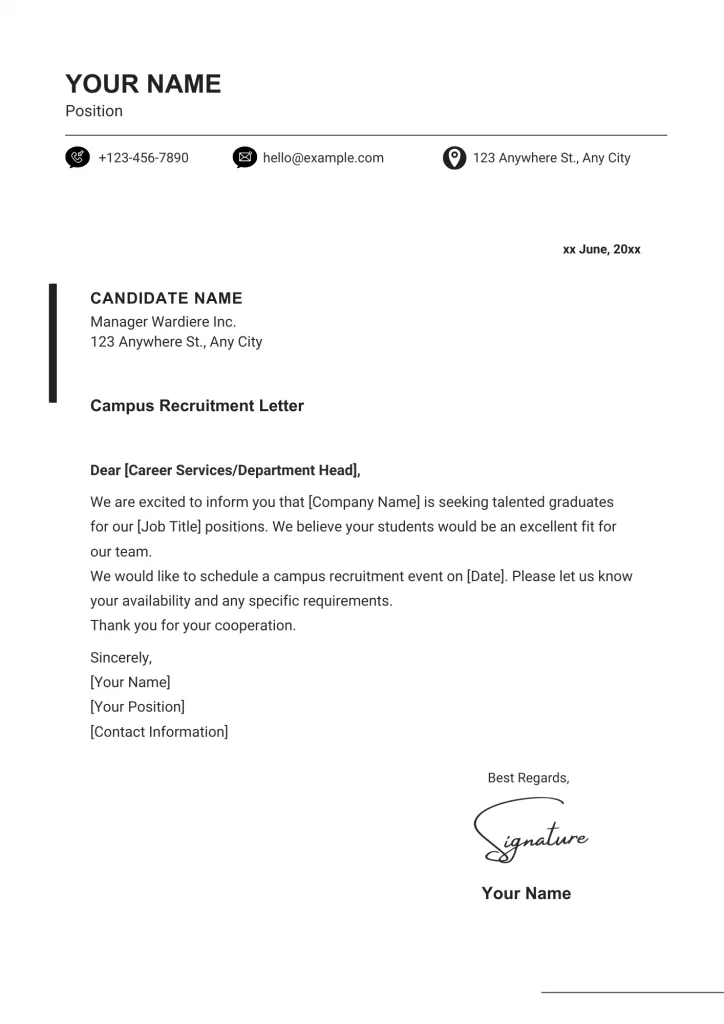
Dear [Career Services/Department Head],
We are excited to inform you that [Company Name] is seeking talented graduates for our [Job Title] positions. We believe your students would be an excellent fit for our team.
We would like to schedule a campus recruitment event on [Date]. Please let us know your availability and any specific requirements.
Thank you for your cooperation.
Sincerely,
[Your Name]
[Your Position]
[Contact Information]
5. General Recruitment Letter
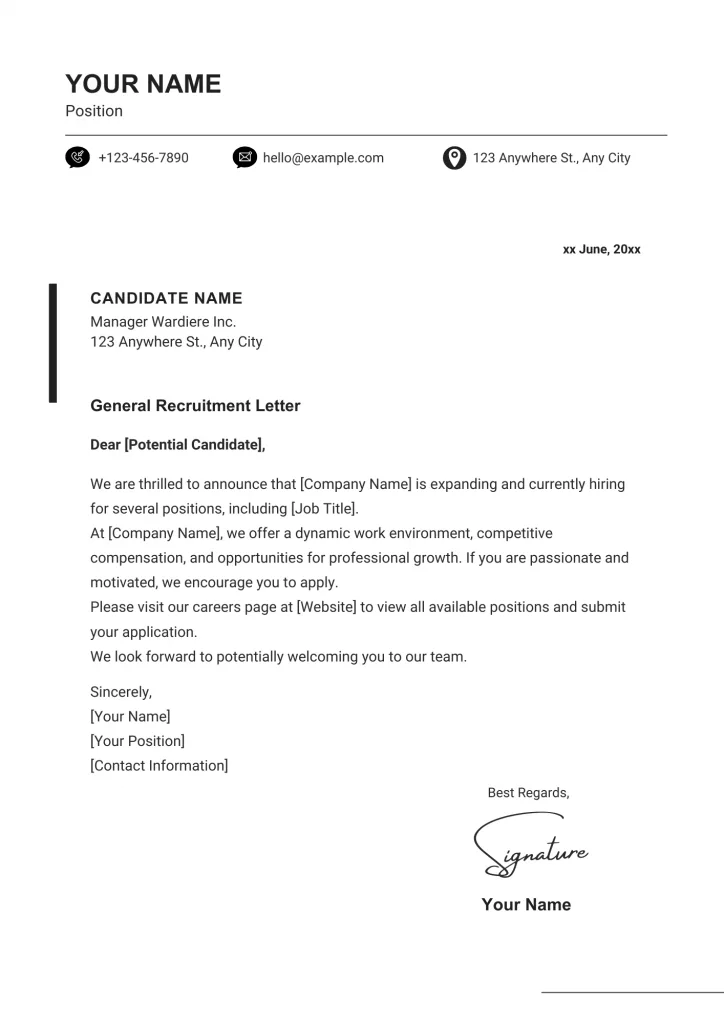
Dear [Potential Candidate],
We are thrilled to announce that [Company Name] is expanding and currently hiring for several positions, including [Job Title].
At [Company Name], we offer a dynamic work environment, competitive compensation, and opportunities for professional growth. If you are passionate and motivated, we encourage you to apply.
Please visit our careers page at [Website] to view all available positions and submit your application.
We look forward to potentially welcoming you to our team.
Sincerely,
[Your Name]
[Your Position]
[Contact Information]
Common Mistakes to Avoid When Writing a Recruitment Letter
Writing for the role, not the candidate. The letter should be about what the candidate stands to gain, not a list of what you need. Most recruitment letters are written from the employer’s perspective. The ones that get responses are written from the candidate’s.
Vague language about culture and values. “We are a fast-paced, collaborative environment that values innovation” means nothing because every company says this. If your culture is genuinely distinctive, describe it specifically. If you cannot describe it specifically, that is a signal about what needs to be fixed before the letter.
Burying the job details. Candidates decide quickly whether a role is worth their time. If the job title, location type, and general compensation range are not visible in the first few lines, most people will not read far enough to find them. Put the essential information at the top.
No sense of urgency or timeline. “Feel free to reach out if you’re interested” is not a call to action. It is an invitation to procrastinate. Tell the candidate when you are looking to move, what the timeline looks like, and why responding now matters.
Using Generic Language. The letter shouldn’t sound generic, polished, and repetitive. You can read the letter on your own or check it through an AI detector. It will highlight the generic lines which you can rewrite afterwards – ensuring that every line is specific to candidates’ roles or the company.
Spelling errors and generic formatting. A recruitment letter with typos tells a candidate exactly how much attention to detail your company brings to its communications. Proofread every letter before it goes out, especially for the candidate’s name.
How to Adapt These Templates for Remote Hiring
Remote recruitment letters require a few additional elements that in-person outreach does not.
Be explicit about the remote setup. Is this fully remote or hybrid? What time zone does the team operate in? How does the company communicate day to day? Candidates considering remote roles have usually dealt with companies that were vague about these details upfront and then created friction later. Being specific about the working arrangement signals that your company has actually thought through what remote work means in practice.
Address compensation early. Remote candidates, particularly those in Latin American markets, are evaluating whether the role represents a strong opportunity relative to their local context. Sharing a rate range in the initial outreach removes a barrier to engagement and signals transparency. Candidates who have to ask about compensation before deciding whether to respond often do not respond at all.
If you are hiring from Latin America specifically, what to look for in a LATAM remote worker covers how to evaluate candidates once they respond, including what to assess for English proficiency, US work culture fit, and role-specific judgment before you commit.
What Happens After the Letter
A strong recruitment letter starts the conversation. What happens next determines whether that conversation becomes a hire.
Have a clear hiring process ready before you send the first letter. If a candidate responds and then waits a week for a reply, the interest you generated with the letter evaporates. Speed of response in the early stages of recruiting is one of the strongest signals to a candidate about how the company operates generally.
Once you have a candidate moving through your process and you are ready to extend an offer, how to onboard a remote virtual assistant in five days gives you the week-one structure that applies to any remote hire. And for what the first 90 days of a new remote working relationship looks like when it is set up correctly, what to expect in your first 90 days with a remote LATAM employee covers the month-by-month picture in detail.
If you are ready to find candidates to send these letters to, browse pre-vetted remote workers from Latin America on Pros Marketplace across roles including virtual assistants, project managers, bookkeepers, and sales representatives. Or post your role today and let qualified candidates come to you.
Frequently Asked Questions
What is the difference between a recruitment letter and a cover letter? A recruitment letter is written by an employer to a candidate, either to invite them to apply, to schedule an interview, or to extend an offer. A cover letter is written by the candidate to the employer as part of an application. They serve opposite purposes in the hiring process but share the same principle: specificity and clarity produce better results than generic templates.
How long should a recruitment letter be? Short enough to be read in under two minutes and specific enough to make the candidate feel the letter was written for them. For general outreach, three to four short paragraphs is the right length. Interview invitations and offer letters can be slightly longer because they include logistical details the candidate needs. The goal in all cases is to give the candidate what they need to take the next step, not to tell them everything about the company in one letter.
What is the most important element of a recruitment letter? The opening line. Candidates decide in the first sentence whether the letter is worth reading. A specific, personalized opening that references something real about the candidate’s background or a genuine problem the company is trying to solve will outperform any generic template regardless of how well the rest of the letter is written.
How do you write a recruitment letter for a remote role? The same principles apply as any recruitment letter, but with three additions: be explicit about the remote setup (fully remote, time zone, communication tools), include compensation or a rate range earlier in the letter, and address how the company actually supports remote work rather than just claiming to. Candidates for remote roles have usually encountered companies that were vague about these details and appreciate employers who address them upfront.
Should you include salary in a recruitment letter? Yes, especially for remote hiring. Including a compensation range or rate in the initial outreach removes a barrier to engagement and signals transparency. Candidates who have to ask about salary before deciding whether to respond often do not respond at all. For remote hiring across Latin American markets specifically, compensation context is one of the first things candidates are evaluating.
How do you follow up if a candidate does not respond to a recruitment letter? One follow-up sent five to seven business days after the initial letter is standard practice. Keep it brief: reference your previous message, restate the opportunity in one sentence, and give them an easy path to respond. If there is no response after the follow-up, move on. Repeated outreach to someone who has not responded signals a lack of process discipline and can damage your company’s reputation with candidates who are in the network of the person you contacted.