Something significant has shifted in how US businesses build their remote teams. More employers are specifically seeking virtual assistants from Latin America, and the reasons go well beyond cost savings. Time zone alignment, English proficiency, cultural familiarity, and work ethic are all part of the conversation now.
If you are a professional in Latin America looking to build a remote career working with US clients, understanding why employers are making this choice is one of the most valuable things you can know. It tells you exactly what they are looking for, what gives you a competitive edge over other candidates, and why the demand for LATAM talent is not a temporary trend.
This post breaks down what is driving US employer preference for Latin American virtual assistants, and what that means for your job search.
US Employers Are Paying Attention to Where You Are Located
For a long time, remote hiring conversations in the US centered on two options: hire locally or hire offshore in Asia or Eastern Europe. Latin America was often overlooked.
That has changed. US businesses have learned through experience that time zone compatibility is not a nice-to-have. It is one of the most practical factors in whether a remote working relationship actually functions well.
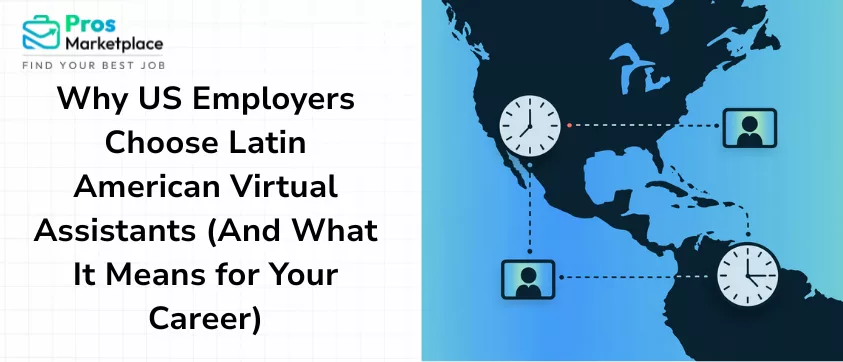
A virtual assistant based in Bogota works on Eastern Time. One based in Mexico City works on Central Time. One based in Buenos Aires is only one to two hours ahead of the US East Coast. That means when your employer sends a message at 9 AM, you are there. When something comes up before a client call, you can handle it in real time. When they need a same-day turnaround, it is possible.
This is the single biggest reason LATAM professionals have a structural advantage over offshore talent from other regions. You are not competing against time. You are working alongside your employer the same way a local hire would, without either of you being in the same city.

What Employers Actually Mean When They Say They Want Strong English
English proficiency is on every VA job description. What employers mean by it is more specific than the phrase suggests.
They are not looking for perfection. They are looking for clarity. The ability to write a professional email that does not require editing. The ability to summarize a research task in plain, organized language. The ability to get on a quick call and communicate without either side struggling to follow the conversation.
Latin American professionals who have worked with US clients consistently meet this bar when they have built their skills in a real working environment. Not just English classes, but actual experience writing client-facing communications, handling correspondence, and operating in a professional setting where English is the working language.
If that describes you, it is worth saying so specifically on your profile and in your applications. Do not just write “fluent in English.” Show it. Your application itself, how it is written, how clearly it communicates your experience, is the first piece of evidence an employer looks at.
For a clear picture of what employers evaluate when they are vetting LATAM candidates, what to look for in a LATAM remote worker is written from the employer side but is worth reading from the candidate side too. It tells you exactly what screening looks like and where most candidates either stand out or fall short.
US Work Culture Familiarity Is a Real Differentiator
Employers who have hired in multiple markets will tell you that the skill gap between candidates is often smaller than the culture gap. Two candidates with similar resumes can produce very different working relationships depending on how well they understand what US employers expect day to day.
What does that mean in practice? US employers generally expect proactive communication. If something is unclear, they want you to ask rather than guess. If a task is running behind, they want to know before the deadline, not after. If you finish what was assigned and are waiting for the next task, they want a brief update rather than silence.
They also tend to prefer written confirmation after verbal conversations. A quick follow-up message after a call that summarizes what was discussed and what the next steps are is considered professional, not excessive. It protects both sides and builds trust.
These norms are not difficult to learn, but they are also not universal. Candidates who have worked with US clients before, or who have actively studied how US professional environments operate, have a genuine edge. If you have that background, make it visible in how you present yourself.

The Roles Where LATAM Demand Is Strongest Right Now
Not all VA roles are equal in terms of demand or earning potential. Understanding where US employers are actively hiring helps you position yourself in the right category.
Executive assistant roles supporting US founders and executives are among the most in-demand. These positions involve calendar management, inbox triage, travel coordination, stakeholder communication, and often a degree of project coordination. Employers filling these roles are looking for someone organized, proactive, and trustworthy with sensitive information.
E-commerce support VAs who understand platforms like Shopify, Amazon Seller Central, or Etsy, and can handle order management, customer service, and supplier coordination, are consistently sought after. Content production and social media management VAs who can schedule posts, monitor analytics, and coordinate with creators are also in strong demand as more businesses invest in digital presence.
Real estate VAs with knowledge of US transaction processes, MLS systems, and client follow-up workflows command some of the higher rates in the VA category because the role requires industry-specific knowledge that not every candidate has.
If your background fits one of these areas, lead with it. Specialists get hired faster and paid more than generalists. Positioning yourself in a niche is almost always the right move if your experience supports it.
What the Earning Potential Actually Looks Like
One of the most common questions Latin American professionals have before pursuing remote US work is whether the pay is actually meaningful once currency differences are accounted for.
The short answer is yes. Virtual assistant roles through Pros Marketplace currently pay $900 to $2,200 per month for full-time engagements depending on experience and specialization. Senior or specialized VA roles can go higher. These are contractor rates paid in US dollars, which carry real purchasing power across all Latin American markets.
For context on how those rates compare across roles and how they have shifted in 2026, the LATAM worker cost breakdown lays it out in detail from the employer side. Reading it gives you a realistic sense of what employers are budgeting and where there is room to negotiate based on your specific skills.

What Employers Expect in the First Week
Getting hired is one milestone. Succeeding in the first week is what determines whether the relationship turns into something long-term.
US employers hiring a remote VA for the first time sometimes underestimate how much structure they need to provide upfront. But even when they do not, there are things you can do as the new hire to set yourself up well regardless of how organized your employer is.
Ask for clarity on priorities before you start working. Confirm which tools you will be using and make sure you have access to everything before day one. Send a brief end-of-day update in your first week summarizing what you worked on and flagging anything you need from them to move forward. These habits make you look professional and organized from the first day and give your employer confidence that they made the right hire.
The five-day VA onboarding framework is written for employers, but reading it as a candidate tells you exactly what a well-organized employer is trying to accomplish in week one and how you can make that process easier for both sides.
Once you are past the first week, how remote teams structure work daily, weekly, and monthly gives you a practical framework for staying productive and visible in a long-term remote role.
Why This Moment Is Worth Acting On
The demand for Latin American virtual assistants is not a niche trend. It is where remote hiring is headed for US businesses that need reliable, English-proficient, time-zone-compatible support at a price point that makes growth possible.
That demand creates real opportunity for professionals in Colombia, Mexico, Argentina, Chile, and across the region who are ready to work at a professional level with US clients.
The window is open. The employers are looking. What they find depends on who shows up with a strong profile, clear communication, and the experience to back it up.
If you are ready to find remote VA work with US employers who are actively hiring, create your free profile on Pros Marketplace and connect with companies that are looking for exactly what you bring.
Frequently Asked Questions
Why do US employers prefer to hire virtual assistants from Latin America? Time zone alignment is the primary reason. Latin American professionals work the same hours as US teams, which makes real-time collaboration possible in a way that offshore markets in Asia or Eastern Europe cannot match. English proficiency, US work culture familiarity, and significantly lower cost compared to domestic hires round out the reasons. For US employers building remote teams, LATAM hits every practical requirement.
What English level do you need to work as a VA for a US employer? Business-level fluency in writing and verbal communication is the standard. Employers are not looking for perfection. They are looking for clarity. The ability to write professional emails, summarize information concisely, and communicate on video calls without friction is what gets candidates hired. How you write in your application and initial messages is the first signal employers use to evaluate this.
What does a Latin American virtual assistant earn working for a US company? Full-time VA roles on Pros Marketplace currently pay $900 to $2,200 per month depending on experience and specialization. Senior executive assistant roles and niche specialists can earn above that range. Rates are paid in US dollars as contractor compensation, which carries strong purchasing power across Latin American markets.
Which countries in Latin America have the strongest demand for remote VA work? Colombia, Mexico, and Argentina have the largest pools of active placements through Pros Marketplace. Chile and Uruguay also produce strong candidates, particularly at the senior level. Brazil has a large talent base but English proficiency varies more by city and industry, which can be a factor for client-facing roles.
What skills make a Latin American VA more competitive for US remote roles? Specialization is the biggest differentiator. VAs with experience in real estate support, e-commerce operations, executive assistance, or content and social media management get hired faster and at higher rates than generalists. Beyond that, proactive communication habits, comfort with US-standard tools like Slack, Asana, Google Workspace, and HubSpot, and a professional online presence all contribute to standing out.
How do you get started finding remote VA work with US employers? Create a complete profile on Pros Marketplace that clearly describes your skills, your experience with US clients if you have it, and the type of work you do best. Apply specifically to roles that match your background rather than sending generic applications. Your first message to a potential employer is an audition. Treat it accordingly.